


VMware: Stay or Leave. Virtualization for a two-site private cloud
Six platforms, one requirement; three meet it. We supply and integrate what passed.
VMware: Stay or Leave is our design study: it compares the virtualization platforms we can source against one written requirement, with no client behind it. The requirement has six clauses, in the buyer's voice, and was fixed before any option was priced. Its shape comes from four public posts by IT buyers, on PeerSpot and the Proxmox forum; its figures come from the sizing in our Data Center Blueprint, and are marked as assumptions.
In short: if either site is lost, its virtual machines run at the other site, 40 km away, within 2 hours, losing no more than 15 minutes of data, from a recovery plan tested twice a year. The licenses on the order cover that recovery, encryption and self-service for five years. Growing from 250 to 400 virtual machines needs no new license. Each machine moves with no more than 2 hours of downtime, using a tool its vendor supports. Microsoft supports Windows Server as a guest, and every other guest is supported by its vendor. The platform vendor takes severity-1 cases around the clock, and the backup product is supported on it, restores included.
Every source is a public page you can open yourself.¹ Anything inferred is marked.
On the public record: Guy's and St Thomas' hospitals in London ran two data centers designed to back each other up; both failed during a July 2022 heatwave that reached 40°C. Not our client. This requirement has two sites 40 km apart and a recovery plan tested twice a year.
1. The six options
Six platforms were assessed, all from vendors whose lines we carry: VMware Cloud Foundation 9.1.1 (Broadcom), the incumbent; Nutanix Cloud Infrastructure with AHV; Red Hat OpenShift Virtualization Engine; Microsoft Azure Local; Microsoft Windows Server 2025 Datacenter with Hyper-V failover clusters; and HPE Morpheus VM Essentials.
Azure Local and Windows Server Hyper-V are sold and licensed differently, so each has its own column. Public cloud and colocation were left out, because the design puts public-cloud extension out of scope. Hardware, network, storage and security vendors were left out because none sells its own hypervisor platform for this requirement.
Platforms we do not carry, such as Proxmox VE, were not assessed.
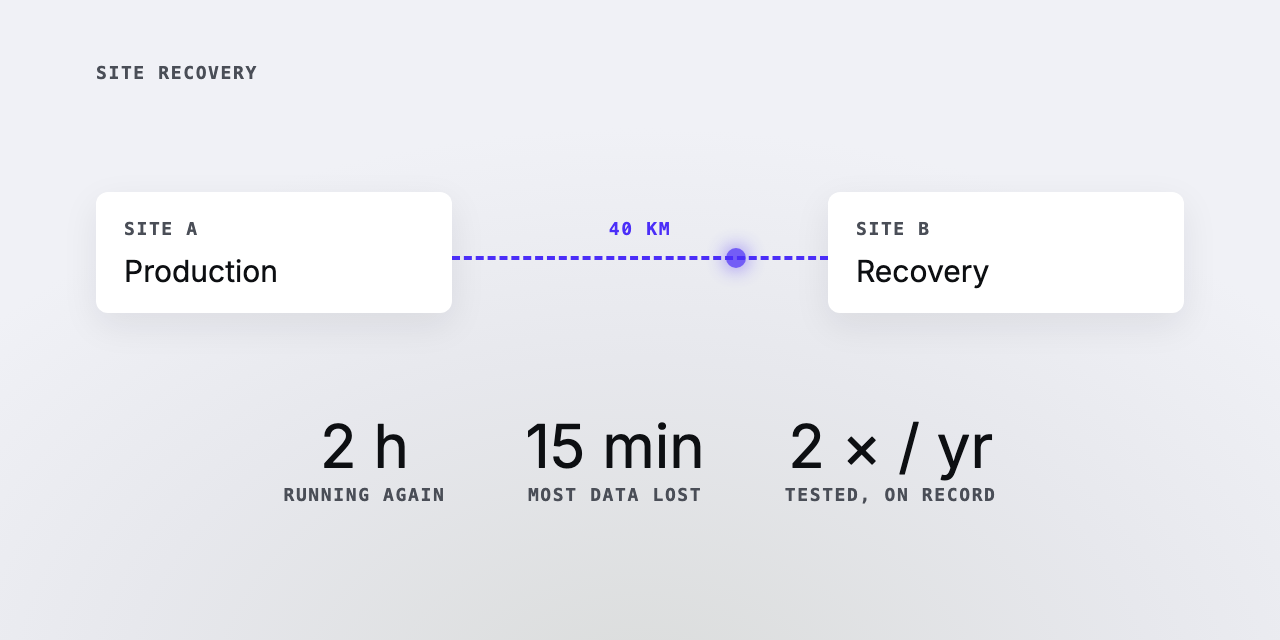
Two sites, 40 km apart: running again within 2 hours, at most 15 minutes of data lost.
2. Which options meet the requirement
Three platforms meet the requirement, each only if named add-ons are on the order: VMware Cloud Foundation with Advanced Cyber Compliance; Nutanix with NCI Ultimate, or Pro with Advanced Replication, plus Nutanix Cloud Manager; OpenShift with Advanced Cluster Management and OpenShift Data Foundation Advanced.
Azure Local and Hyper-V stay open on site recovery: Microsoft's documents show replication and test failover, but we found no multi-VM recovery plan with a test record. The full table shows each cell. HPE Morpheus VM Essentials is set aside: we could not confirm it on Microsoft's validated Windows Server list.
No vendor publishes a per-machine downtime figure, so the 2-hour migration clause is marked "decided at the pilot" for every option. It does not set any option aside.
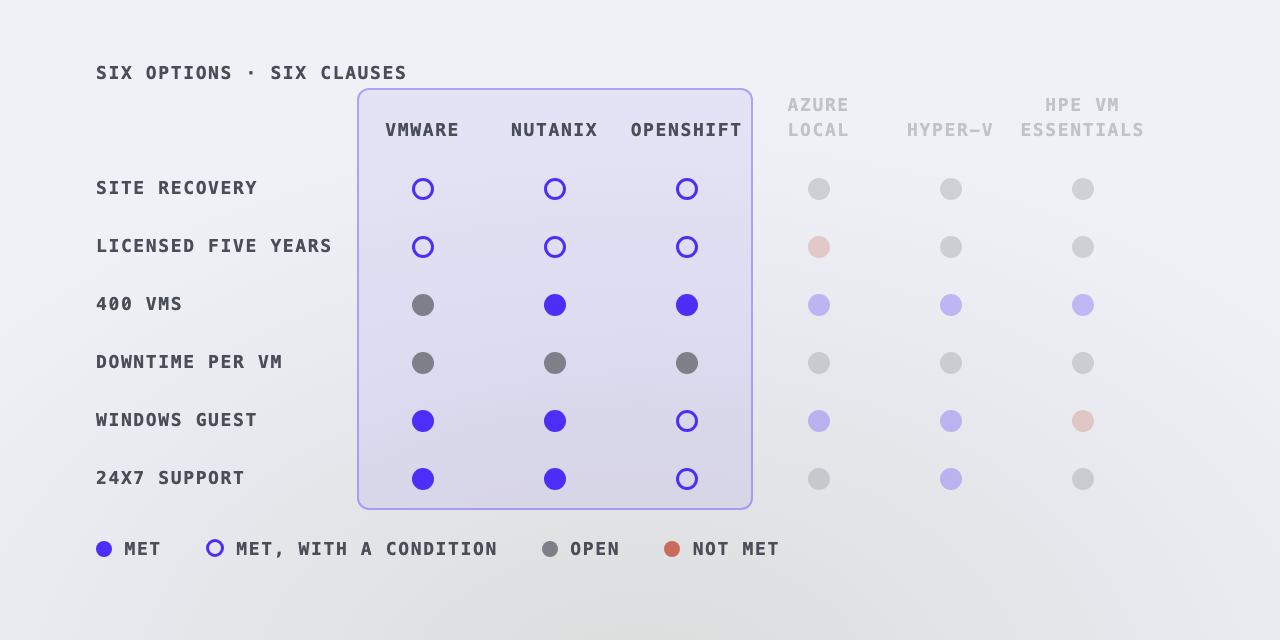
Six options against six clauses, as in the table.
3. Why price does not rank them
Price is weighed only among options that met every line. For those three, a key add-on has no public price: Advanced Cyber Compliance for VMware, and OpenShift Data Foundation Advanced for OpenShift; for Nutanix no public price states its term. Ranking them would mean guessing, so they are not ranked. The cost row names, for each option, the parts with no published price. The buyer's own quote for those parts decides between the three. As on every comparison, no price figure is published.
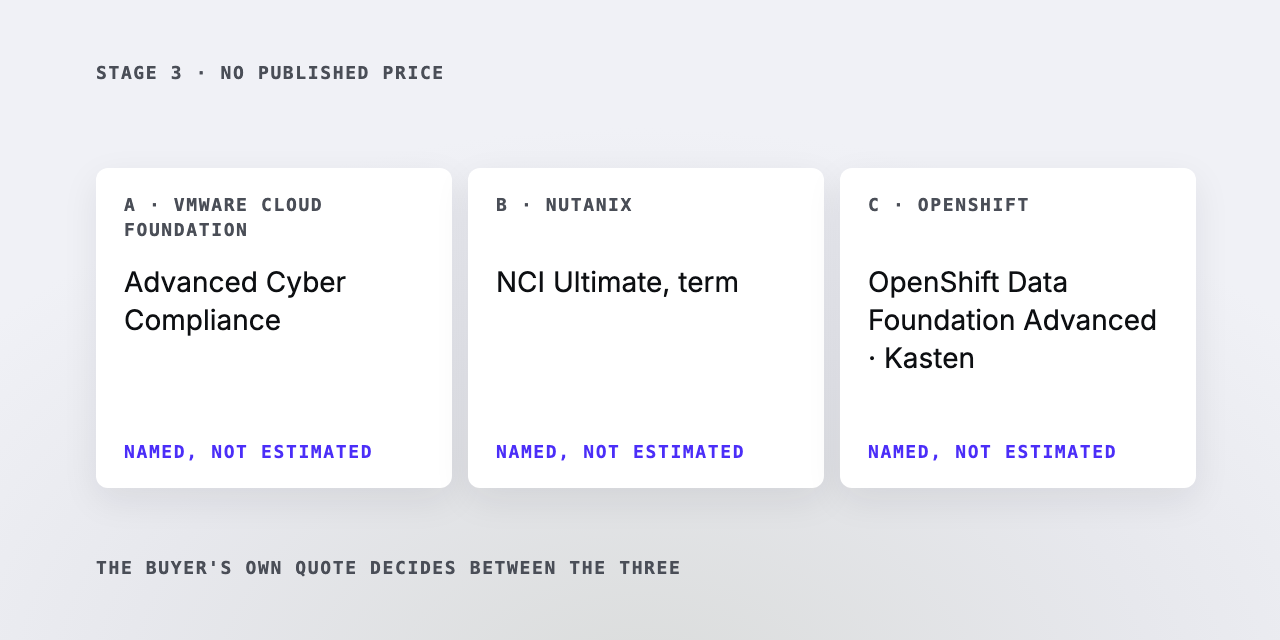
Where no price is published, the part is named, never estimated.
4. What we recommend
We recommend the three platforms that met every line: VMware Cloud Foundation, Nutanix Cloud Infrastructure and Red Hat OpenShift Virtualization Engine. Your quote for the named add-ons decides between them; for VMware, the quote must also confirm the license unit for recovery as the estate grows to 400 machines. We supply and integrate all three: ask us for that quote.
What splits this field is not whether the hypervisor works. It is what must be added to the base license to meet the recovery and licensing clauses.
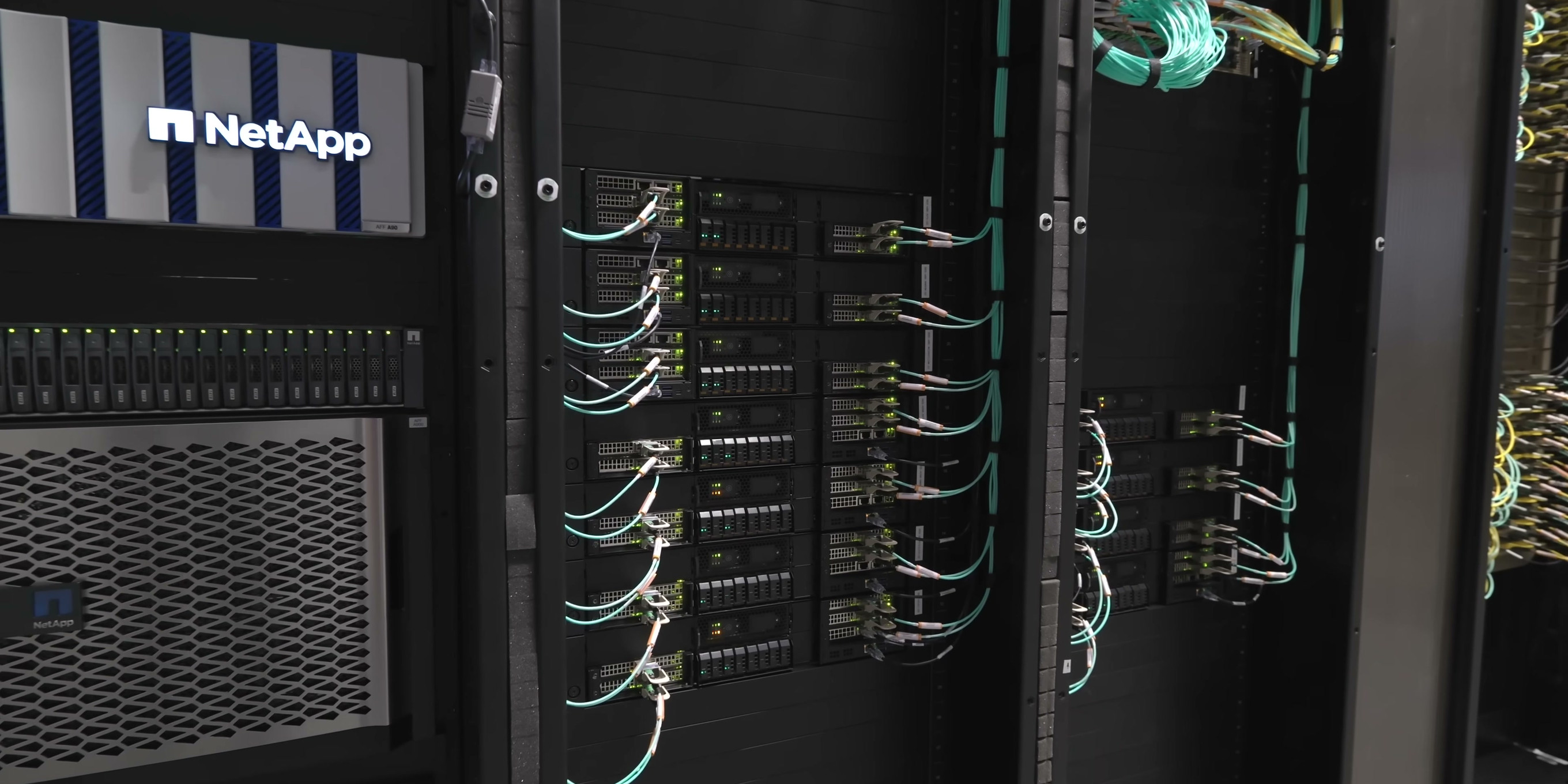
Storage and its fiber in a rack.

Confirmed by the engineer before you order.
Written by Steve Phillips, Principal Data Center Architect.² Edwin Ozer answers for it too. Every cell is in the full table. Every source is listed under Sources below.
The recovery clause for OpenShift and both Microsoft options, the license unit for VMware recovery, NVMe drive sizes, and each platform's hardware list for the chosen servers.
Ask AI about this comparison: Claude · ChatGPT · Perplexity · Google AI Mode
Opens in a new tab with the question filled in.
Confirmed by the engineer before you order.
Written by Steve Phillips, Principal Data Center Architect.² Edwin Ozer answers for it too. Every cell, with its source, is in the full table.
The recovery clause for OpenShift and both Microsoft options, the license unit for VMware recovery, NVMe drive sizes, and each platform's hardware list for the chosen servers.
Ask AI about this comparison: Claude · ChatGPT · Perplexity · Google AI Mode
Opens in a new tab with the question filled in.
Sources
The public pages this comparison was read from, by option.¹
The requirement: public posts by IT buyers
- PeerSpot: what needs improvement with VMware vSphere
- PeerSpot: what needs improvement with Hyper-V
- Proxmox forum: migrating 500 VMs from VMware with little downtime
VMware Cloud Foundation
- Broadcom: counting cores for VMware Cloud Foundation
- Broadcom: VCF 9.1 licensing overview
- Broadcom: purchasing a subscription for VMware Live Recovery
- VMware: Advanced Cyber Compliance FAQ (PDF)
- VMware: VCF 9.1 general FAQs (PDF)
- StarWind: VMware licensing changes (search summary)
- Licenseware: VMware licensing change (search summary)
Nutanix Cloud Infrastructure
Red Hat OpenShift Virtualization Engine
- Red Hat: self-managed OpenShift subscription guide
- Red Hat: OpenShift Virtualization Engine
- Red Hat: OpenShift Data Foundation disaster recovery
- Red Hat: certified hypervisors
- Red Hat: Migration Toolkit, cold and warm migration (search summary)
- Veeam: Kasten for OpenShift Virtualization
Microsoft Azure Local
- Microsoft: Azure Local pricing page
- Microsoft: stretched clusters
- Microsoft: VM resiliency and disaster recovery
- Microsoft: what is new in Azure Migrate for Azure Local
- Microsoft: VMware migration overview
- Microsoft: security features
- Microsoft: Azure support plans
Microsoft Windows Server 2025 with Hyper-V
- Microsoft: Windows Server pricing page
- Microsoft: Hyper-V Replica overview
- Microsoft: stretch cluster replication
- Microsoft: VM conversion extension
HPE Morpheus VM Essentials
- HPE: Morpheus virtualization software
- Microsoft: Windows Server validated hypervisor list
- Microsoft: validated hypervisor program